Renny Cushing 1952– 2022 in memoriam

Renny Cushing, one of the founders of the World Coalition Against the Death Penalty, has passed away this year, which precisely marks the 20th anniversary of that foundation. Renny was always present to witness the presence of children of anti-capital murder victims. His testimony was always very impressive and others were adding to his. He was a Democratic deputy in the New Hampshire congress and managed to abolish capital punishment there On the occasion of his death Mario Marazziti, founder of the NGO San Egidio that deals with poverty and solidarity and also with the abolition of the death penalty and maintains the annual initiative of the night of the illuminated cities against capital punishment has written the following text that we reproduce:


Mario Marazziti.

Meet the amazing Renny!


“It was bitterly cold outside the Glass Palace in New York on December 17, 2000. We were a small demonstration after three million signatures collected from around the world by Sant'Egidio were handed over to Kofi Annan, calling for an end to the death penalty. We were there Susan Sarandon, Helen Préjean, Tim Robbins, others, Renny Cushing, who I didn't know very well, a human rights activist.

Seven years later, in 2007, at a key moment for the historic adoption of the first resolution for a universal moratorium by the UN General Assembly, there were five million signatures from 152 countries, from all cultures and religions, that we delivered the day before the vote to the President of the Assembly. These petitions radically rejected the argument that had blocked everything for 15 years, namely that the moratorium was an imposition of the European vision of human rights, a “cultural imperialism”.


The day before, we had dinner in New York with Sister Helen Prejean and Renny, who had meanwhile founded the MVFHR association, Murder Victims’ Families for Human Rights, along with others in 2004: “When a death row inmate is killed, other victims are created, who are certainly innocent: the children, the wives, the parents, the friends of those who are premeditatedly killed by the State”Renny declared. “Eliminating the perpetrator or alleged perpetrator only adds one more death and has nothing to do with healing the victims' pain.”.

He knew whereof he spoke. On June 1, 1988, a neighbor, a retired police officer, knocked on the door as on other occasions. But when he opened the door Mr. Cushing, a professor “progressive” of Irish origin, who had questioned the beating given by the police to a detained girl when she was going to a party, opened the door, the former policeman had become a murderer. Two shots to the chest, blood in the hallway and on the walls. In his way, a “political assassination”, a “lesson”. Renny is the one who cleaned his house of the marks of this hate. “Before my father's murder, I had already developed a framework of values ​​that included respect for life and rejection of the death penalty. For me to change these values ​​and beliefs because my father had been assassinated would only have given more power to his assassins, who would not only take away his life, but also what he transmitted to me. This is also true for society, because the death penalty turns us all into murderers: it turns us into what we are horrified and abhorred.


Death was not satisfied: a few years later, her brother's husband was also murdered. But it wasn't easy to break Renny. He was then captain of the high school football team, when he had long sideburns, a restless boy, committed Christian and curious about the world who, at 16, had bought a travel card to cross the United States by road. Wanting to go to New Orleans, he ended up in California. “I'm a hopeless romantic, an aging revolutionary”he joked.

A human fighter. One of those who want to change the world since they were children and who would not stop until his last day, at 69 years old. Generation of gospel Y beat. In a provincial world I already had a passport at the age of 18. He visited Latin America and eventually Louisiana, where he saw the same latent hatred that had murdered M.L. King in Memphis, Tennessee, in 1968: he always kept the picture of him in his office as the leader of the New Hampshire Democrats. He was once arrested when he and the Clamshell Alliance marched down the train tracks to stop the construction of the Seabrook Nuclear Power Plant.


But in his life accompanying the families of the victims, telling them that only forgiveness can begin to heal and that only life can repair what has been shattered, he did not stray far from this house green as penicillin. “Staying in that house was the way to get my life back. My roots could not be taken from me. And it was transformed. The ground where my father's blood pools were is where my daughters learned to crawl and walk. “A tenacious, Renny.

Thus, New Hampshire, a Republican state whose motto is “Live free or die”, abolished the death penalty on the fourth attempt. It had already been abolished by a majority, but the governor vetoed it. A year later, in 2019, the Senate approved it by more than two-thirds of the vote, making the governor's veto impossible. Senator Ward, a Republican whose family member had also been killed, also voted with Renny. A man with a cult of friendship and a global vision, respected even by his opponents. He also spoke of the harmfulness of his cancer. He was afraid that he would not be able to finish what he had started. However, the abolition of the death penalty and life are stronger because Renny no longer has the limitations of time and space and the final fatigue of his body and, as they say in these cases, he continues to fight with us. . “

Network activities in 2021

The Network for the abolition of the death penalty and cruel punishment prepared a program of 5 seminars for the year 2021, directed by Luis Arroyo Zapatero and Cristina Rodríguez Yagüe, and coordinated by Beatriz García-Moreno, which addressed the main thematic axes of the net.

Continue reading

Cádiz hosted the Congress of Young Researchers in February 2022

On February 17 and 18, 2022, the congress on the death penalty and cruel punishment aimed at young researchers took place in Cádiz. María Acale, Professor of Criminal Law at the University of Cádiz, directed the conference and also had a scientific committee made up of Luis Arroyo Zapatero, Ignacio Berdugo, Lucía Martínez Garay, Mercedes Pérez Manzano, Alicia Gil, María Acale, José Luis de la Cuesta, Juan Terradillos, Anabela Miranda, Luigi Foffani, Juan Antonio Lascurain.

The complete program can be consulted clicking here.

Tables-abstracts relationship:

THE DEATH PENALTY AGAINST HUMAN RIGHTS, JUDICIAL GUARANTEES AND VULNERABLE GROUPS

THE DEATH PENALTY IN THE WORLD

LONG-TERM SENTENCES AS ALTERNATIVES TO THE DEATH PENALTY (I)

LONG-TERM SENTENCES AS ALTERNATIVES TO THE DEATH PENALTY (II)

LONG-TERM PENALTIES, DANGEROUS AND SECURITY MEASURES

Roger Hood 1936 – 2020 in memoriam

Roger Hood 1936 - 2020 in memoriam

At the end of September, he sent me an affectionate letter in response to the one I had sent announcing the soon beginning of the research project on cruel punishment of which he was the chairman of the advisory council. He transferred his sorrow to me after the loss of his wife, Nancy; now he was alone in life and scared by the covid in his apartment on the Thames Fisherman's Path in Oxford. With his extraordinary sense of humor, he compared the situation of so many during the first part of the pandemic with "solitary confinement", which is the cruelest way to serve a prison sentence and which is the critical object of so many of our academic works. He indicated to me his willingness to contribute to the book "Images of Cruelty" with a timely commentary on a British gallows. He attached his latest publication on the difficulties in abolishing the death penalty in the Anglo-Saxon Caribbean and announced that the two of us would meet in the tribute book to Hans Jörg Albrecht. But suddenly he got sick a few weeks ago and on November 17 he passed away.

Descargar

By Luis Arroyo Zapatero (Picture: Sofía Moro)

At the end of September, he sent me an affectionate letter in response to the one I had sent announcing the soon beginning of the research project on cruel punishment of which he was the chairman of the advisory council. He transferred his sorrow to me after the loss of his wife, Nancy; now he was alone in life and scared by the covid in his apartment on the Thames Fisherman’s Path in Oxford. With his extraordinary sense of humor, he compared the situation of so many during the first part of the pandemic with “By Luis Arroyo Zapatero (photo: Sofia Moro)”, which is the cruelest way to serve a prison sentence and which is the critical object of so many of our academic works. He indicated to me his willingness to contribute to the book “Images of Cruelty” with a timely commentary on a British gallows. He attached his latest publication on the difficulties in abolishing the death penalty in the Anglo-Saxon Caribbean and announced that the two of us would meet in the tribute book to Hans Jörg Albrecht. But suddenly he got sick a few weeks ago and on November 17 he passed away.

Download

Farewell to Professor Christof Heinz

It is with a heavy heart that the Academic Network for the Abolition of the Death Penalty bids farewell to Professor Christof Heyns who passed away on March 28th. His demise will be widely felt by the academic community and by human rights activists. Professor Heyns was Director of the Institute of International and Comparative Law at the University of Pretoria, former member of the United Nations Human Rights Committee and United Nations Special Rapporteur on extrajudicial, summary and arbitrary executions from 2010 to 2016, are noteworthy his visits to Honduras where he analyzed “the situation of violence” and examined the measures adopted to prevent attacks against the life, safety and physical integrity of people.¨ or to Chad where he asked that the country return to the moratorium on the death penalty after the execution of Islamic terrorists without the guarantees of the International Law, stating that capital punishment "is an extreme form of punishment and, if it is used, it should be imposed after a fair trial that respects the strictest procedural guarantees as stipulated in international human rights law."

In the office she was replaced by Agnes Callamard and the prestige that her work achieved is proof of the threat her successor suffered from members of the Saudi royal family due to the description she made of the extrajudicial execution and prior torture of the journalist Kashogi in the embassy of this country in Turkey.

At the regional level, he was also a member of the Working Group on the Death Penalty, Extrajudicial, Summary and Arbitrary Murders, and Enforced Disappearances in Africa of the African Commission on Human and Peoples' Rights. In these roles her work drew attention to highly sensitive issues such as the use of force by private security companies in law enforcement contexts; the use of drones and autonomous weapons in armed conflicts or anti-terrorist operations; and the forensic role in protecting the right to life.

Our Organization had the opportunity to share meetings in international forums for the protection of human rights and it was always a privilege to listen to their opinions and participate in intense debates to guarantee the right to life and to enjoy an environment free of violence.

REPECAP- Academicsforabolition joins the large number of institutions and individuals who regret the untimely departure of Dr. Christof Heyns.
Rest in peace.-

It is with great sadness that the international Academic Network for the Abolition of the Death Penalty bids farewell to Professor Christof Heyns who passed away last March 28th. His passing will be widely felt by the academic community and by human rights activists.

Professor Heyns was Director of the Institute of International and Comparative Law at the University of Pretoria former member of the United Nations Human Rights Committee and United Nations Special Rapporteur on extrajudicial, summary and arbitrary executions from 2010 to 2016, his visits to Honduras where he analyzed “the situation of violence” and examined the measures taken to prevent attacks on the life, safety and physical integrity of persons are noteworthy. ¨ or to Chad where he called for the country to return to a moratorium on the death penalty following the execution of Islamic terrorists without the guarantees of international law, indicating that capital punishment ¨ is an extreme form of punishment and, if it comes to be used, should be imposed after a fair trial that respects the strictest procedural guarantees as stipulated by international human rights law”.

He was replaced in the office by Agnes Callamard and the prestige of her work is evidenced by the threat to her successor by members of the Saudi royal family for her description of the extrajudicial execution and torture of journalist Kashogi at the Saudi embassy in Turkey.

At the regional level he was also a member of the Working Group on the Death Penalty, Extrajudicial, Summary and Arbitrary Killings and Enforced Disappearances in Africa of the African Commission on Human and Peoples’ Rights. At these functions his work drew attention to highly sensitive issues such as the use of force by private security companies in law enforcement contexts; the use of drones and autonomous weapons in armed conflicts or counter-terrorism operations; and the forensic role in the protection of the right to life.

Our Organization had the opportunity to share meetings in international forums for the protection of human rights and it was always a privilege to listen to their opinions and participate in intense debates to guarantee the right to life and to enjoy an environment free of violence.

REPECAP- Academicsforabolition joins the large number of institutions and individuals who mourn the untimely departure of Dr. Christof Heyns.

May he rest in peace

In memoriam Nigel Rodley

Interview, Madrid 2009

Foundation of the International Academic Network against the death penalty

Center for Political and Constitutional Studies and UCLM.

Tribute edition to Nigel Rodley, who passed away on January 25 of this year 2017 and in gratitude for his participation in the founding Congress of the Academic Network against the Death Penalty (academicsforabolition.net) to support the birth of the International Commission Against Death Penalty (icomdp.org) that occurred in 2010.

Born in Yorkshire in 1941. His father Hans Israel Rosenfeld was killed fighting the Nazis in the Netherlands at the end of 1944. He studied law at Leeds and Columbia Universities. He was the first head of Amnesty International's legal department. He has been a Professor at the New School for Social Research and at the London School for Economics and since 1990 Professor at the University of Essex. He has been an advisor to various United Nations bodies, especially, Special Rappateur on torture (1993-2000) and later a member of the Human Rights Committee until 2016.

At the initiative of President Jose Luis Rodriguez Zapatero, a founding congress of the International Academic Network was held in December 2009 at the Center for Political and Constitutional Studies with the most qualified specialists in Human Rights from five continents, including Sergio García Ramírez, Mireille Delmás Marty, Cherif Bassiouni, William Schabas, Shizu Wang, Michael Radeled and Nigel Rodley himself. Throughout it, careful interviews were carried out by Marta Muñoz de Morales, Manuel Maroto and Domingo Ruiz, which later allowed the composition of the Audio-book "Still Killing” to train in abolition in Spanish, English and Arabic, which accompanies more than 12 books that have been published since then, most of which are available online on the portal www.academicsforabolition.net.

In gratitude for his participation and in his memory we publish the interview we did with him on the doctrine of the United Nations Human Rights Committee on the Death Penalty and of which he was a member and even its President.

See video.

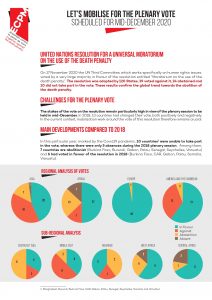
Let’s mobilise for the plenary vote scheduled for mid-december 2020

UNITED NATIONS RESOLUTION FOR A UNIVERSAL MORATORIUM ON THE USE OF THE DEATH PENALTY
On 17 November 2020 the UN Third Committee, which works specifically on human rights issues, voted by a very large majority in favour of the resolution entitled “Moratorium on the use of the
death penalty”. The resolution was adopted by 120 States, 39 voted against it, 24 abstained and 10 did not take part in the vote. These results confirm the global trend towards the abolition of
the death penalty.

Challenges for the plenary vote The stakes of the vote on the resolution remain particularly high in view of the plenary session to be held in mid-December. In 2018, 13 countries had changed their vote, both positively and negatively.

In the current context, mobilization work around the vote of this resolution therefore remains crucial. Main developments compared to 2018

In this particular year, marked by the Covid19 pandemic, 10 countries1 were unable to take part in the vote, whereas there were only 5 absences during the 2018 plenary session. Among them,
7 countries are abolitionist (Burkina Faso, Burundi, Gabon, Palau, Senegal, Seychelles, Vanuatu) and 6 had voted in favour of the resolution in 2018 (Burkina Faso, CAR, Gabon, Palau, Somalia,
Vanuatu).

For a truly human justice

Audience of Pope Francis with the Association Internationale de Droit Pénal, Société Internationale de Criminologie, Société Internationale de Défense Sociale, International Penal and Penitentiary Foundation, World Society of Victimology and the Latin American Association of Criminal Law and Criminology.

Download document