

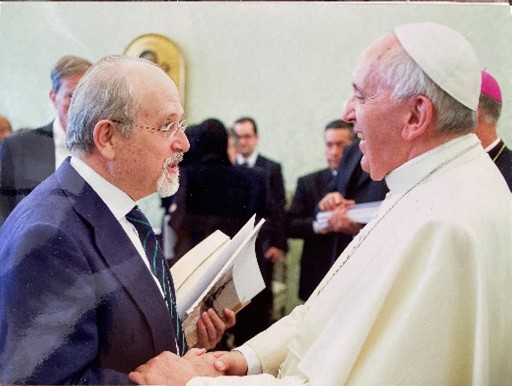
Luis Arroyo Zapatero and Antonio Muñoz Aunión
Honorary Rector of the University of Castilla La Mancha and president of the International Society for Social Defense / Professor of International Law at the University of Jaen and director of the International Death Penalty Network
The first surprise that Pope Francis gave us was that he addressed not only Catholics or Christians, but all people of good will. And the first surprise for the jurists was that on his first Holy Thursday in 2013, instead of going to wash the spotless feet of twelve cardinals in the Vatican, he went to the youth prison of Regina Coeli and he washed the feet of precisely twelve young people, two of them women and, to top it all off, one of them Muslim. It was all said like that. He did it again this last Holy Thursday. Just in case, a few days later he published an “Apostolic Exhortation”, with a severe criticism of what has been called neoliberalism and that had led to the 2008 crisis, condemning millions of people to misery and denouncing the treatment of them as “discarded”. Shortly afterwards he published the first encyclical, Laudato yes, with which he put an end to the frivolous or denialist treatment of climate change.
When I learned about the entire life of the new Pope, I realized that the hasty visit to the island of Lesbos had a lot to do with the status of his parents as Italian emigrants and with the tragedy that usually accompanies migrations, as happened to those who embarked on the ship for which they had paid for the tickets that was going to take them to the Americas and which was shipwrecked and quite a few died, and on which they did not manage to board because they had not yet been able to sell all their belongings.
Pope Francis had already spoken out against the death penalty without exceptions before penalists from around the world and their international scientific organizations in Rome in 2014. In the same process he formulated the full disqualification of life imprisonment as a hidden death penalty. But although the catechism drafted in the 1992 edition by John Paul II had broadly disqualified the death penalty, it maintained it as an exception in section 2267 for "cases in which this was the only way to effectively defend human lives from the unjust aggressor", a clause that allowed its abusive use in many countries, as occurs in systems that claim to be exceptional. Extremist Catholics relied on that exception to defend or excuse it.
On March 20, 2015, a private audience of the Pope took place with Federico Mayor Zaragoza, president of the International Commission against the Death Penalty, which had been created in 2010 at the request of President José Luis Rodríguez Zapatero. He was accompanied by Asunta Vivó, general secretary of the Commission, Roberto Carles, general secretary of the Latin American Association of Penal Lawyers and Criminologists and the undersigned. It is severely impressive to be alone with the Pope around the table in that office that we have seen so many times when he receives the heads of state. Seeing the Pope dressed like that and speaking in Spanish produced an almost physical sensation. Neither he nor Federico Mayor stopped talking about everything, except the death penalty, because when Francisco sat down he moved a text to Mayor on the table and told him “I'll take care of this matter.” So Mayor went on to warn about the men of peace who had been assassinated from Kennedy to Isaac Rabin. Francisco said of him in Argentine that he was “a great one.” The Pope told what he intended to say in the American Congress and in the UN during his immediate trip, which Mayor took advantage of to warn him about the Republicans, although as a reader of his first apostolic exhortation he knew that it was well illustrated. We did not know it until later, but the Pope had just been informed that the next morning at an open-air mass in Naples a possible attack by the Mafia had been detected, which does not forgive the Pope for excommunicating them. The same thing happens to them as many Catholic conservatives, who do not like the Pope telling them what is wrong.
A few months later we went to the Vatican to present to the Pope the book that the scientific societies had published accompanying his text “For truly human justice.” When, after giving José Luis de la Cuesta the book, I went to introduce myself, he didn't give me the chance to finish. "You are the one with the death penalty," he snapped at me, and then ordered, "and tell Mayor and our friend from Seville - Asunción Milá de Salinas, founder of the Spanish Association against the death penalty in 1977 - that I have asked Cardinal Schönborn of Vienna to study the matter and I have told him to hurry up." This was the case, fortunately, and on August 1, 2018 it was announced by the Spanish Jesuit Cardinal Luis Ladaria, president of what was first the Inquisition, then the Holy Office and which since 1965 has been called the Congregation for the Doctrine of the Faith. It is not just a name change, it is the renunciation of the purifying fire.
The letter, expressly approved by the Pope, states that, if in the past the death penalty may have seemed an acceptable instrument for the protection of the common good, today the awareness is increasingly vivid that the dignity of the person is not lost even after having committed very serious crimes. It also says that a new understanding has spread about the meaning of criminal sanctions, that they must be oriented above all to the rehabilitation and social reintegration of criminals and, finally, that effective detention systems have been implemented that guarantee the necessary defense of citizens, all of which has given rise to a new awareness that recognizes the inadmissibility of the death penalty. The letter assumes previous arguments of the Pontiff himself, especially that the death penalty implies cruel, inhuman and degrading treatment, which is applied with extensive social and racial discrimination and which is irreparable in the face of judicial errors. To substantiate everything, we refer to the letter delivered to the president of the International Commission Federico Mayor Zaragoza. Indeed, the Pope, as he told us in the aforementioned meeting, had taken charge of the matter and fulfilled what was within the sphere of his competence, while maintaining his commitment to the international abolitionist movement. The Pope reaffirmed the meaning of the reform of the catechism in his address to the members of the International Commission against the Death Penalty on the occasion of his visit on December 17, 2018. There the Pope recognizes that, in the previous time, that of the first reforms of the relevant article of the catechism, "the current level of development of human rights had not been reached and the recourse to the death penalty was presented as a logical and just consequence. Even in the Papal State it was had resorted to this inhuman form of punishment, ignoring the primacy of mercy over justice.” With the renewed catechism, the official doctrine is that “the death penalty is always inadmissible, because it violates the inviolability and dignity of the person.”
For the times of the Church the process has been very fast. Grounding abolition in the idea of the dignity of human beings was a great contribution to the 70th anniversary of the Universal Declaration of Human Rights. Francis has been very consistent with his program of reforms and renewed ideas since his very first apostolic exhortation in 2013 and his critical vision of the international economic order, with his Encyclical on caring for the environment, Laudato Si, with his campaign against hunger or his key diplomatic actions in places of war such as Ukraine, Iran, Syria and in recent years again on Ukraine and Gaza, or on risky visits such as to the Central African Republic or Chile, although here for very different reasons.
The Pope was above all a normal person, who had known ordinary studies, friendships and the treatment of boys and girls and as an adult he had lived through the Argentine tragedy in which the violence that incorporated sectors of Liberation Theology was responded to by genocidal soldiers who, yes, attended daily mass and after receiving communion from the hands of the nuncio and the primate, coldly ordered the prisoners to be thrown from military planes into the high seas, after countless tortures. He did what he could while being superior of the Jesuits at that time and “what he could” is always a lot in a dictatorship and has great merit. Between a violent theology and a genocidal theology, he was entrusted with carrying out the “theology of the common good” and he has also dedicated all these years of papacy to this. Until the last day. The text of his blessing is worth reading City and the World Sunday on the Vatican website and complete it with what was his first Easter Sunday in 2013. It is clear that he was a beneficent reformist, a friend of human beings of good will, an unconditional supporter of the needy and the discriminated against. In this stormy time we have lost a good compass to pursue the common good.
But the last day has also encouraged us to believe in hope, a principle that is also the title of his latest book, Hope never disappoints, and that leads me to remember his first Holy Year, that of the Misericordia, which is the classic word for what we call today Solidarity.
No comment yet, add your voice below!